







Curriculum
Bala Vatika
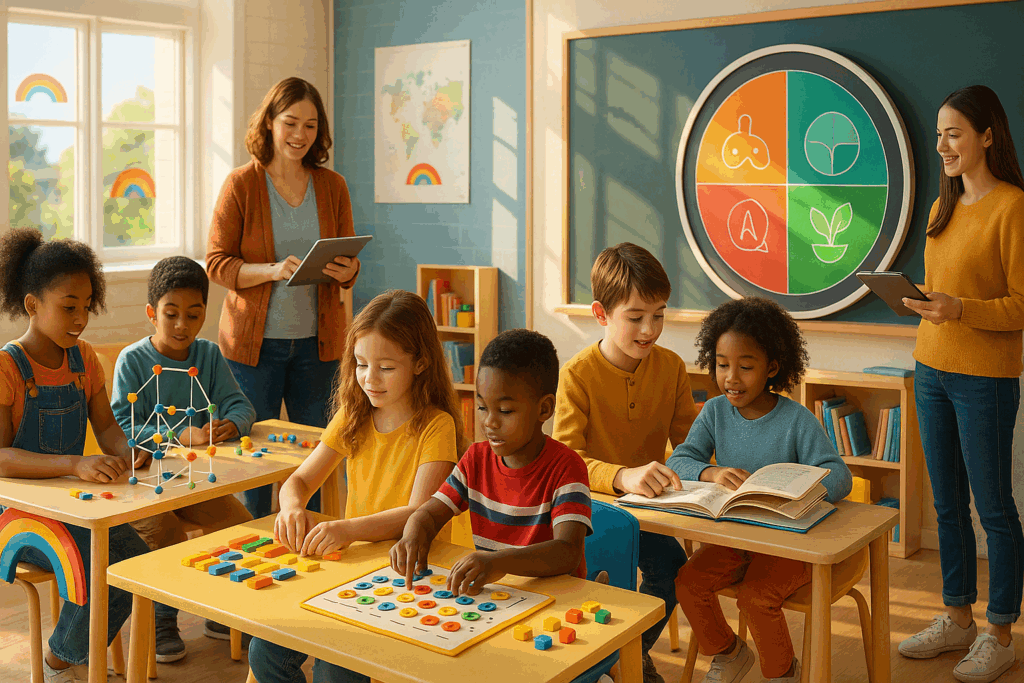
Bal Vatika is an early childhood education initiative that goes beyond traditional classroom settings to create an enriching environment for children aged 3 to 6 years. Emphasizing play-based learning, the program aims to foster cognitive, social, emotional, and physical development in the crucial early years of a child’s life.
Play-Based Learning
Bal Vatika places a strong emphasis on learning through play, recognizing that young children learn best when engaged in hands-on, interactive activities. The program incorporates educational games, storytelling, music, and creative arts to make learning enjoyable and meaningful.
Holistic Development
The curriculum is designed to address all facets of a child’s development, including cognitive, social, emotional, and physical domains. Bal Vatika activities promote language development, motor skills, problem-solving abilities, and emotional intelligence.
Inclusive Environment
The initiative is committed to creating an inclusive and welcoming environment for all children. Activities are designed to accommodate diverse learning styles and abilities, ensuring that every child can participate and benefit from the program.
Parental Involvement
Recognizing the crucial role of parents in a child’s early years, Bal Vatika encourages active parental involvement. Parents are provided with insights into their child’s learning experiences and are given guidance on how to support their child’s development at home.
Transition to Formal Education
Bal Vatika acts as a bridge between informal early childhood education and formal schooling. The program aims to make the transition to formal education smoother, preparing children with foundational skills and a love for learning.
Benefits of Bal Vatika
Early Literacy and Numeracy Skills
Through age-appropriate activities, Bal Vatika lays the groundwork for early literacy and numeracy skills, setting the stage for future academic success.
Social and Emotional Well-being
The program helps children develop strong social and emotional skills, fostering positive relationships with peers and adults.
Curiosity and Creativity
Bal Vatika encourages a sense of wonder and curiosity, nurturing the innate creativity of young minds.
Smooth Transition to School
By introducing children to a structured learning environment, Bal Vatika eases the transition to formal schooling, promoting a positive attitude toward education.
Primary School
The Curriculum prescribed by CBSE strives to:
- Provide ample scope for holistic i.e., physical, intellectual and social development of students
- Emphasize constructivist rather than rote learning by highlighting the importance of hands-on experience
- Enlist general and specific teaching and assessment objectives to make learning competency based and attain mastery over laid down competencies
- Encourage the application of knowledge and skills in real-life problem-solving scenarios
- Uphold the ‘Constitutional Values’ by encouraging values-based learning activities
- Promote 21st Century Skills, Life Skills, Financial Literacy, Digital Literacy, Health and Wellness, Road Safety, Citizenship Education, Disaster Management and multilingualism
- Integrate innovations in pedagogy such as experiential, activity centered, joyful learning, Sport & Art-Integrated Learning, toy-based pedagogy, storytelling, gamification etc. with technological innovations (ICT integration) to keep pace with the global trends in various disciplines
- Promote inclusive practices as an overriding consideration in all educational activities
- Enhance and support learning by different types of assessments; and strengthen knowledge and attitude related to livelihood skills
- Foster multilingual and multicultural learning and national understanding in an interdependent society
- Integrate environmental education in various disciplines from classes I- XII
CBSE envisions the all-round development of students in consonance with the holistic approach to education and, therefore, has done away with artificial boundaries between the co-curricular and the curricular domains. Secondary Curriculum provides students with a broad and balanced understanding of subjects including languages, Mathematics, Science, and Social Science to enable students to communicate effectively, analyse and interpret information meaningfully, make informed decisions, construct their worldview in alignment with constitutional values, and progress smoothly to be productive future citizens. The recent focus of CBSE is on developing 21st-century skills in settings where each student feels independent, safe, and comfortable with learning. The Board hopes that schools will try to align the curriculum in a way children feel more connected to it and employ their learning in real-life contexts. To achieve this aim, it is essential that children acquire adequate knowledge and skills in other core areas like Health and Physical Education, Life Skills, Values Education, Art Education, Financial Literacy, Digital Literacy, and Work Education. In an operational sense, the secondary curriculum is learner-centered with school being a place where students would be acquiring various skills; building self-concept, a sense of enterprise, aesthetic sensibilities, and sportsmanship. Therefore, for the purpose of fostering core competencies in learners, this curriculum encompasses major learning areas.